

“The Carbon Credit Market Is Not Reserved for Large Corporations Alone”

According to Ms. Đặng Hồng Hạnh, Co-founder and CEO of VNEEC, even households and local communities can benefit from carbon credit revenues, provided they engage in suitable project models.
Carbon Credit Mechanisms: Opportunities and Challenges for Vietnamese Businesses
In her presentation titled “Carbon Credits – Understanding Them Right to Unlock Carbon Finance Potential,” delivered at the forum “Carbon Credits – New Opportunities from Green Pressure” organized by Dan Tri Newspaper in collaboration with the For a Green Future Foundation under Vingroup, Ms. Hạnh highlighted that Vietnam’s carbon market consists of two segments: compliance and voluntary.
In the compliance market, industries such as clinker production, crude steel, and thermal power are required to conduct greenhouse gas (GHG) inventories, are subject to emission caps, and can trade allowances on a state-regulated carbon exchange. Meanwhile, the voluntary market allows emission reduction projects to generate carbon credits under domestic or international standards, which can be traded directly or via voluntary platforms.
Under Vietnam’s Law on Environmental Protection, a carbon credit represents the right to emit one metric ton of CO₂ (or its equivalent). While emission allowances are allocated by regulators to permit emissions, carbon credits reflect efforts to reduce, remove, or avoid emissions through projects such as renewable energy, agriculture, afforestation, and waste treatment.
However, not all emission reduction projects qualify for carbon credits. Key requirements include legal compliance, measurable and verifiable emission reductions, the use of approved methodologies, and the principle of additionality, meaning the project would only be viable with carbon credit revenue. Credits must also be unique, traceable, and non-duplicative.

Globally, there are hundreds of methodologies across sectors, from renewable energy to agriculture and waste management. Vietnam is also participating in mechanisms under the Paris Agreement to ensure transparency and avoid double counting.
Contrary to common misconceptions, Ms. Hạnh emphasized that the process of generating carbon credits is complex and typically takes one to two years, involving multiple stages with third-party validation, monitoring, and verification. In Vietnam, transactions are often conducted via bilateral contracts, commonly under a “pay now, deliver later” structure.
International carbon credit prices are determined by supply and demand, as well as factors such as technology type, project location, co-benefits (social and environmental), and project risk.
Since 2009, Vietnam has registered 274 projects under the Clean Development Mechanism (CDM), but only 87 have issued credits, totalling nearly 33 million, primarily from hydropower and renewable energy. Vietnam has also engaged in joint crediting mechanisms with Japan, with 14 pilot projects to date.
Popular international standards in Vietnam include Gold Standard (GS), with 67 registered projects and around 5 million credits issued, and Verified Carbon Standard (VCS), with more than 14 million credits issued, largely from renewable energy, biogas, and waste treatment projects.
Globally, carbon credit standards are becoming increasingly stringent to ensure quality and transparency. The Integrity Council for the Voluntary Carbon Market (ICVCM) currently recognizes only 12 methodologies, meaning many previously eligible projects no longer meet updated criteria.
From 2025, Vietnam will pilot its domestic carbon market, allowing businesses to use carbon credits to offset up to 30% of their emission quotas. At the same time, the country is engaging in negotiations under Article 6 of the Paris Agreement, opening opportunities for cooperation with partners such as Singapore, Japan, South Korea, and Switzerland.

For businesses, carbon credits present both challenges and opportunities. While project registration requires time, resources, and strict compliance, it can also generate sustainable revenue, enhance ESG credibility, and improve access to green finance.
Companies are therefore advised to proactively study applicable standards, develop project strategies early, and build capable expert teams to keep pace with evolving international regulations.
A Strategic Market Requiring Long-Term Vision
Viewing carbon credits as a form of commodity, Ms. Hạnh noted that Vietnamese businesses may initially act as both buyers and sellers, depending on the market segment.
In the voluntary market, most Vietnamese companies currently act as sellers, as domestic demand for voluntary carbon neutrality remains limited. Buyers are primarily international organizations. However, this trend is shifting, with some sectors, particularly aviation, beginning to purchase international credits to meet emission offset requirements.
In the compliance market, companies allocated emission quotas may use credits for partial offsets. They may act as buyers if credit prices are lower than allowance costs, or as sellers if they invest in credit-generating projects elsewhere.
This dynamic underscores the need for well-defined investment strategies. High-quality carbon credits are expected to see rising demand, while lower-quality credits may lose value. Businesses must therefore select appropriate mechanisms, register projects at the right time, and strictly comply with standards. There have already been cases where projects with strong potential failed to register in time, resulting in missed commercialization opportunities.
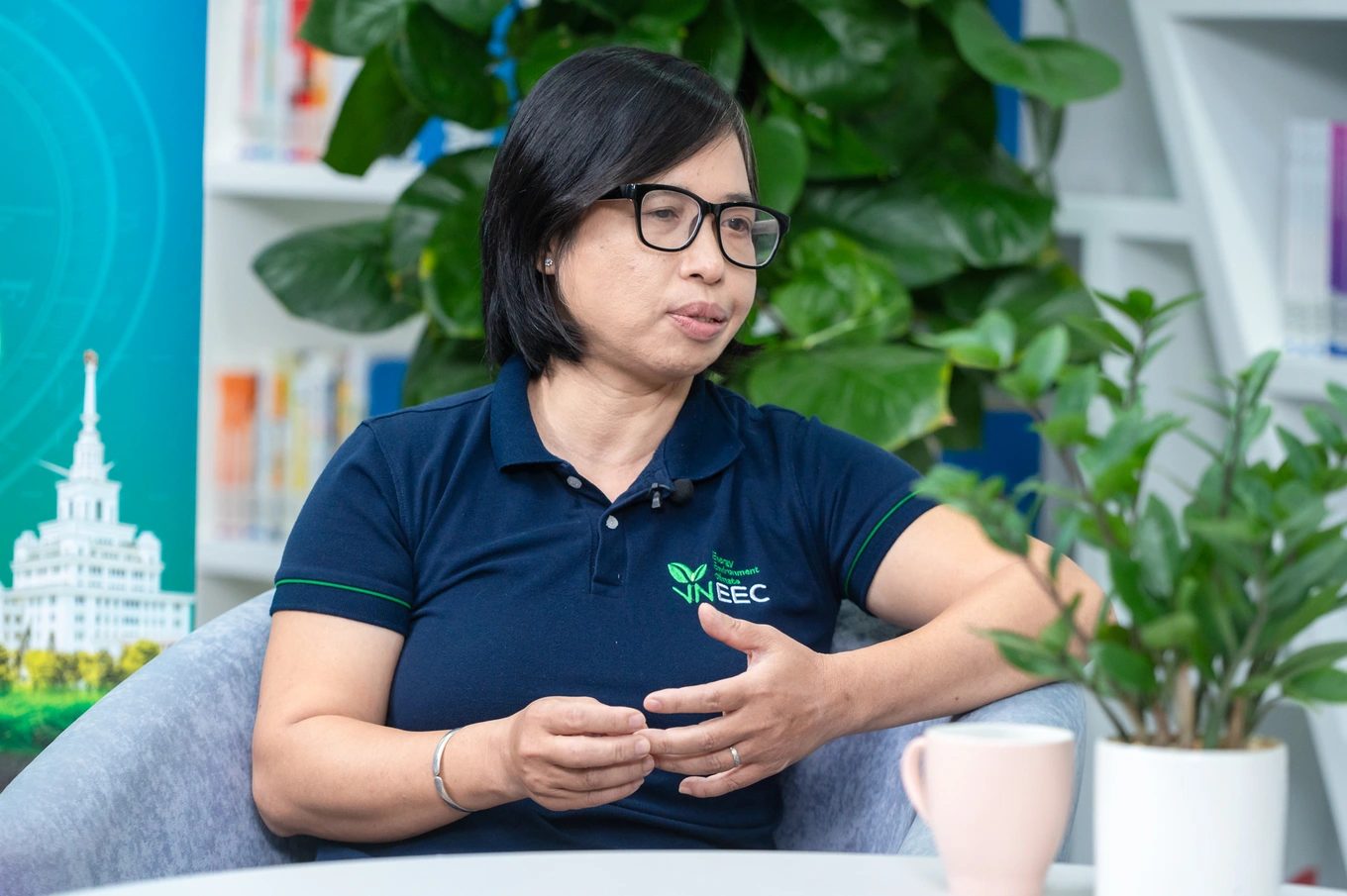
Businesses are advised to pay close attention to legal and contractual risks when participating in carbon credit transactions in both domestic and international markets (Photo: Thành Đông).
Addressing the question of whether carbon markets are only for large corporations, Ms. Hạnh acknowledged that large enterprises do hold advantages in capital and scale. However, this does not exclude small and medium-sized enterprises.
In forestry projects, for example, households and local communities participating in afforestation and forest protection can also benefit from carbon credit revenues.
Vietnamese businesses are also exploring renewable energy certificates such as I-REC. Compared to carbon credits, I-REC is simpler, converting 1 MWh of renewable electricity into one certificate, but offers lower value and a narrower scope of application. Carbon credits, by contrast, are more widely recognized, involve stricter processes, and carry higher value.
“Many businesses choose I-REC as the ‘low-hanging fruit’ for quick returns, whereas carbon credits require long-term investment but deliver more sustainable benefits,” Ms. Hạnh noted.
Regardless of the chosen pathway, businesses are advised to carefully manage legal and contractual risks. In voluntary markets, key risks relate to credit quality and delivery commitments. In compliance markets, failure to report accurately or exceeding emission caps may result in penalties under national regulations.
“Lessons from the period following 2013, when the United States withdrew from the Kyoto Protocol and global carbon prices collapsed, show that contracts can be disrupted by external shocks. To participate safely and effectively in carbon markets, businesses must adopt cautious strategies, long-term vision, and strict compliance with the rules,” Ms. Hạnh concluded.